Here’s How to Choose the Right One for You
When the power goes out, having a reliable generator can make all the difference. But with so many options available, it can be overwhelming to figure out what size generator you actually need. At Maverick Electric, Heating and Air, we understand the importance of having a generator that meets your specific needs. In this post, we’ll walk you through how to determine the right size generator for your home or business.
The Bottom Line
Most homes need a 5,000–7,500-watt portable generator to cover essentials like the fridge, lights, and a sump pump, or a 15,000–20,000-watt whole-house generator to run everything, including HVAC. The right size depends on your square footage, electrical panel amperage, and which appliances you want powered during an outage.
What Happens If Your Generator Is the Wrong Size?
Get the size wrong, and you’ll find out the hard way, usually in the middle of an outage.
If you select a generator that’s too small, it may not power your essential appliances, leaving you in the dark. On the other hand, choosing a generator that’s too large can be a waste of money and fuel.
By selecting the right size, you ensure that your generator can handle your power needs efficiently without overloading or wasting resources.
Step 1: How Many Watts Do You Need? (Appliance Wattage Chart)
The first step in determining the right generator size is understanding your power requirements. Start by making a list of all the essential appliances and systems you want to keep running during a power outage. Common household items include:
- Refrigerator and freezer
- Lighting, especially in key areas like bathrooms and hallways
- Heating or air conditioning systems, especially if you live in a hot climate
- Medical equipment, if necessary
- Home office equipment, if you work from home
Here’s roughly what those essentials draw in running watts:
|
Appliance |
Typical Running Wattage |
|
Refrigerator/freezer |
600–800W |
|
Sump pump |
1,000–1,500W |
|
Central air conditioning |
2,000–4,000W |
|
Water heater |
3,000–4,500W |
|
Furnace fan |
500–1,000W |
|
Lighting (per room) |
60–200W |
|
Medical equipment |
Varies — check your device label |
To calculate the total wattage you’ll need, add up the running watts for each item, then add the starting watts for your largest motor-driven appliance: Running Watts + Starting Watts (usually 2–3x the running watts for anything with a motor) = Total Wattage Needed. Most appliances have their wattage listed on a label or in the user manual. If you’re unsure, our licensed electricians can assess your needs and recommend the right generator size.
Step 2: Starting Watts vs. Running Watts — What’s the Difference?
When shopping for a generator, you’ll come across two important terms: starting wattage and running wattage.
- Starting wattage is the surge of power needed to start an appliance, like a refrigerator or air conditioner.
- Running wattage is the amount of power required to keep that appliance running.
Bottom line:
- Your generator’s starting-wattage capacity must exceed your highest single-appliance surge.
- Total running wattage must stay under the generator’s continuous rated output.
Step 3: Portable vs. Whole-House Generator — Which Do You Need?
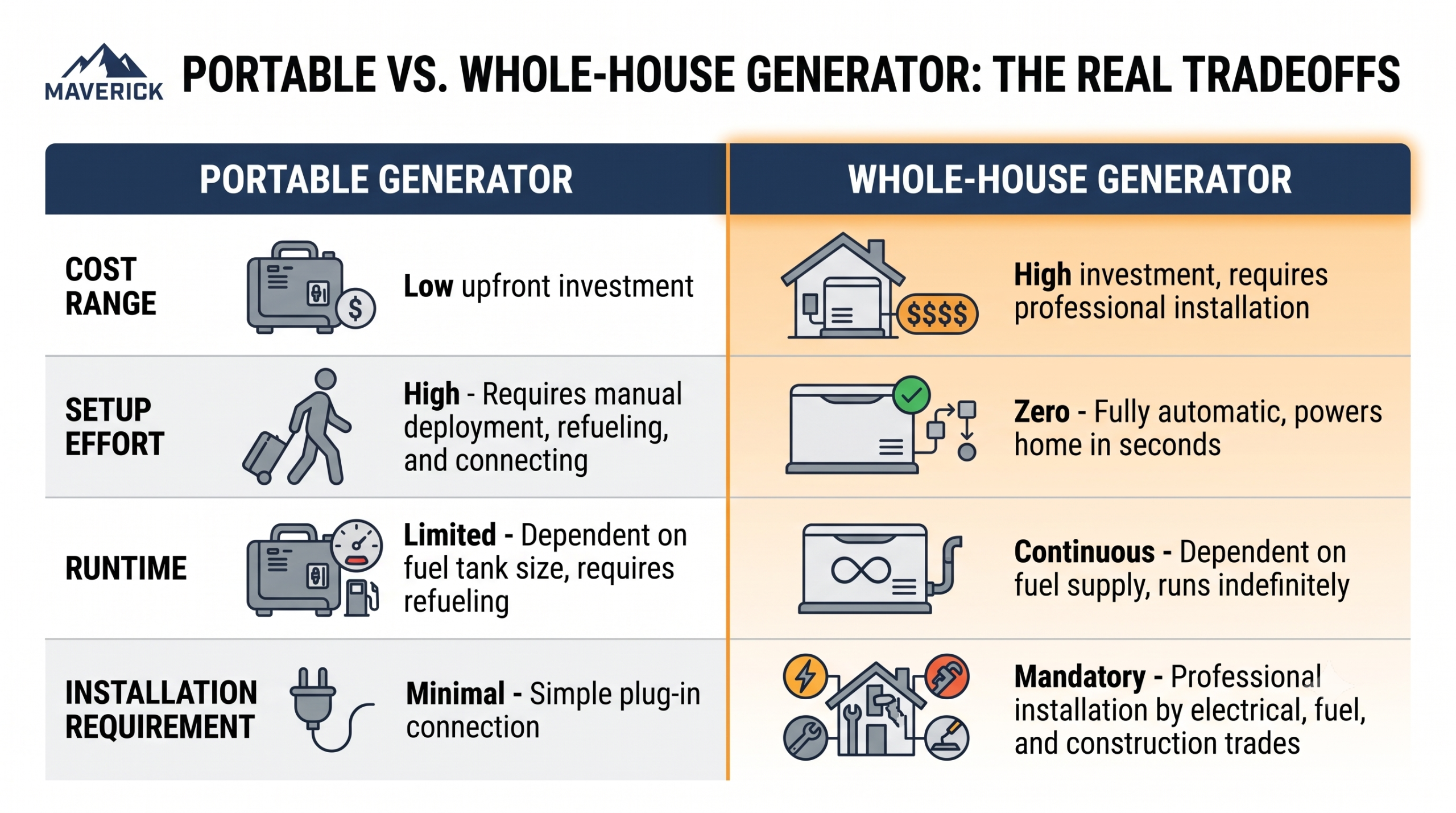
With your wattage number in hand, the next decision is portable or whole-house. There are two main types:
- Portable generators: smaller and more affordable, perfect for powering a few key appliances or tools.
- Whole-house generators: larger and more expensive, capable of powering an entire home, including major appliances, HVAC systems, and more.
Fuel matters too. Portable units typically run on gasoline. It’s cheap and available, but you’re limited by how much you can store on hand, which won’t carry you through a multi-day outage. Whole-house generators run on natural gas or propane, so as long as the gas line or propane tank holds, the generator keeps running. That’s a real advantage during the longer outages PG&E’s Public Safety Power Shutoffs (PSPS) can trigger across Sacramento, Placer, and El Dorado counties during fire season.
If you’re in an area like Sacramento or Folsom, where power outages can be frequent, a whole-house generator may be a good investment. However, if you only need backup power for a few key appliances, a portable generator might be more than enough.
Here’s how the two stack up side by side:
|
Portable Generator |
Whole-House Generator |
|
|
Cost Range |
$500–$2,500 |
$5,000–$15,000+ installed |
|
Setup Effort |
Wheel it out, fuel it, run cords |
Automatic — kicks on within seconds of an outage |
|
Runtime |
Limited by fuel you can store on hand |
Runs as long as your gas/propane supply lasts |
|
What It Powers |
A few key appliances or tools |
The entire home, including HVAC and water heater |
|
Installation Requirement |
None — plug and go |
Licensed electrician required: permit, gas hookup, transfer switch |
Not sure which one fits your situation? Book Your Free Same-Day Generator Consultation. Our team offers same-day service across our service area.
How Your Electrical Panel Size Affects Generator Sizing
Here’s something most online wattage calculators won’t tell you: your home’s electrical panel puts a hard ceiling on what a generator can actually do, regardless of how many watts the unit is rated for.
A 100-amp panel is common in older homes and limits how much you can realistically back up, usually just the essentials. Step up to a 150-amp or 200-amp panel, and you get more headroom for whole-house coverage, including HVAC. Larger homes with 300-amp or 400-amp service (or a sub-panel setup) can support the biggest whole-house generators on the market, but the interconnection still has to be sized and wired correctly by a licensed electrician.
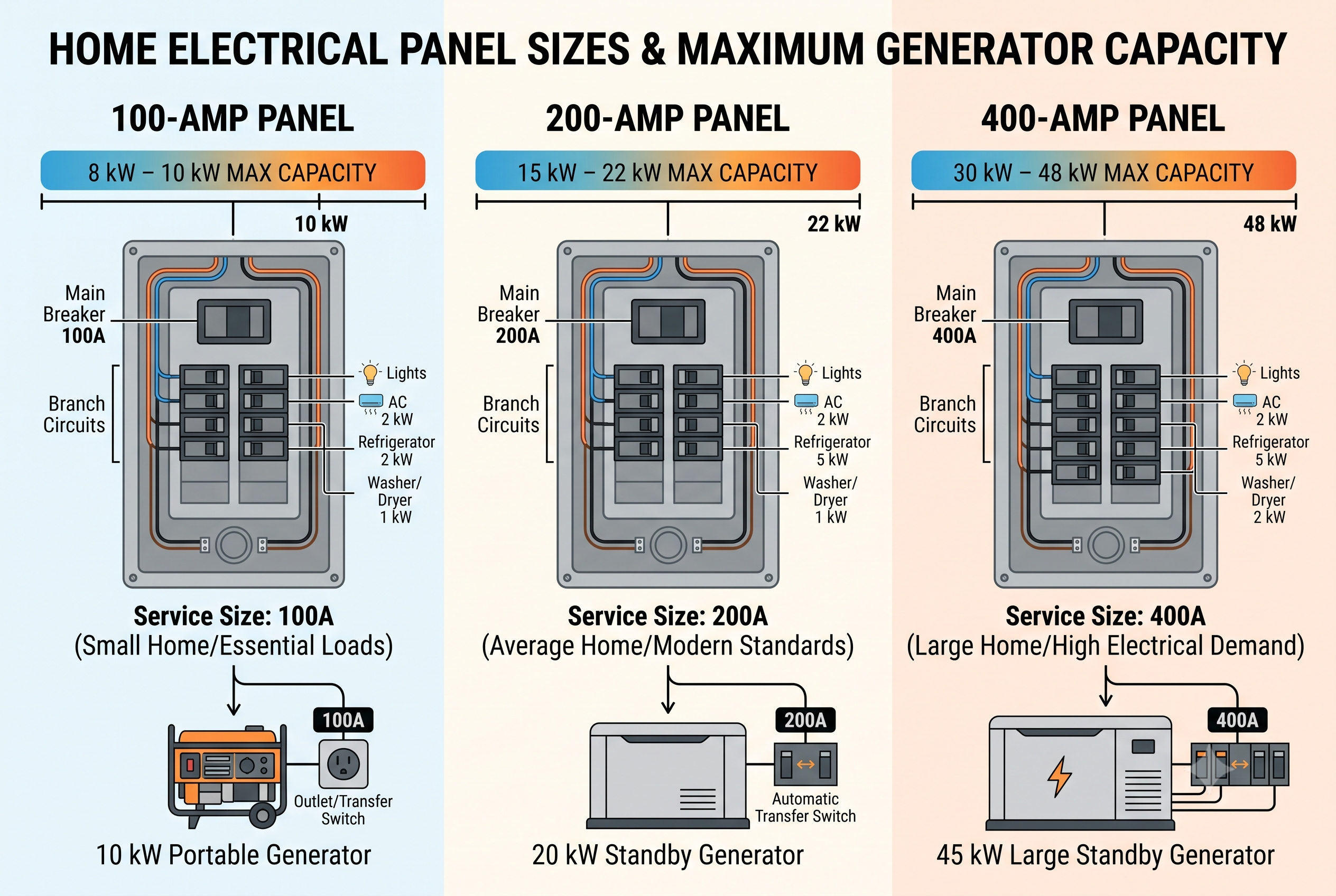
That’s the piece of the puzzle a generator retailer can’t assess for you. Getting it right requires an on-site electrical inspection, not a spec sheet.
Not sure what amp service your home has? Get a Free Panel Check before you buy anything.
Step 4: Do You Need a Professional to Size and Install a Generator?
Still not sure? That’s exactly what a professional electrician is for.
Here’s the honest answer: sizing a portable generator for a few essentials is something most homeowners can figure out with a wattage chart and some patience. A whole-house standby generator is a different animal. In California, it requires a permit, a code-compliant gas or electrical hookup, and a licensed electrician to tie the transfer switch into your panel safely. Skipping that step isn’t just a code violation; it can jeopardize your homeowner’s insurance coverage if something goes wrong.
Maverick’s been doing this kind of work since we started out of a garage in 2020. The company was founded by the son of a lineman and an electrician, so getting the wiring right isn’t a sales pitch for us. It’s the family business. We’re licensed, bonded, and insured (CSLB #1068288), and we pull the permits so you don’t have to think about it.
At Maverick Electric, Heating and Air, our expert electricians can help you assess your power needs and recommend the right generator for your home or business. We offer whole-home generator installation, maintenance, and repair services for both portable and whole-house generators, so you have reliable backup power when you need it most.
Generator Installation & Repair Across Sacramento, Placer, and El Dorado County
Whether you’re in Sacramento, Roseville, Elk Grove, Folsom, Rancho Cordova, or Citrus Heights, Maverick Electric, Heating and Air is here to help. We also serve homeowners throughout El Dorado, Placer, Solano, Sutter, Yolo, and Yuba counties. Our team of licensed electricians specializes in generator installation and maintenance, ensuring your home or business is always prepared for a power outage.
Get the Power You Need — Before the Next Outage Hits
Don’t wait for the next power outage to find out that your generator isn’t the right size. Get a Free Same-Day Estimate on what size generator you need. Our team is ready to make sure you have the power you need, whenever you need it.
Call us today at (916) 655-7744 for expert advice on selecting and installing the perfect generator for your home or business. Serving Sacramento, Roseville, Elk Grove, Folsom, Rancho Cordova, and Citrus Heights!
Frequently Asked Questions About Generator Sizing
What size generator do I need to run a 2000 square-foot house?
The size of the generator needed to power a 2000 square-foot house depends on the number of appliances and systems you want to run. On average, a 2000 square-foot house requires a whole-house generator with a wattage range of 7,500 to 10,000 watts to cover essential appliances like your refrigerator, lights, HVAC system, and water heater.
If you’re looking to power everything in your home, including larger systems, consider a 10,000-watt generator. However, if you’re only looking to keep critical systems running, a smaller generator might suffice. Our expert electricians at Maverick Electric, Heating and Air can help you choose the right generator size based on your specific needs in Sacramento, Roseville, Elk Grove, and surrounding areas.
Is a 5000-watt generator big enough for a house?
A 5000-watt generator may not be sufficient for an entire house, but it can power a few essential appliances such as lights, a refrigerator, and a small HVAC unit. It’s ideal for smaller homes or when you only need backup power for critical devices.
Running larger appliances, a water heater, multiple air conditioning units, or other big draws, will require a generator with higher wattage. Need help deciding? Maverick’s team offers personalized sizing and installation guidance for homes in Folsom, Rancho Cordova, and beyond.
What will an 8000-watt generator run?
An 8000-watt generator is capable of powering several essential appliances, including:
- Refrigerator and freezer
- Lighting throughout the house
- Some air conditioning or heating systems
- Power tools or small appliances
- Sump pumps or well pumps
This size generator is ideal for homes that need backup power for essential items but don’t require the full capacity of a larger generator. Maverick’s electricians can walk you through the right fit during a consultation. We serve Citrus Heights and the surrounding area.
What will a 10,000-watt generator run?
A 10,000-watt generator is large enough to power most homes, including larger appliances and systems. Here’s what a 10,000-watt generator can typically run:
- Central air conditioning unit
- Refrigerator and freezer
- Lighting throughout the entire house
- Water heater
- Power tools or multiple small appliances
- Several fans or space heaters
This generator size is often recommended for homes with high electricity demands or homes that need backup power for most major systems. For a generator this size, it’s worth getting a professional load calculation first. Our Sacramento-area team can help.
Can I use a 7500-watt cord on an 8000-watt generator?
Yes, you can use a 7500-watt extension cord on an 8000-watt generator, as long as the cord is rated to handle the power your generator produces. The cord’s wattage rating should be equal to or greater than the generator’s output to prevent overheating and keep the connection safe.
Don’t cut corners here. Choose a cord that’s properly sized for your generator’s output. Our licensed electricians can recommend safe, effective generator connections for Roseville, Folsom, or any surrounding area.
How do I calculate the total wattage I need?
Add up the running wattage of every appliance you want to power, then add the starting wattage of your largest motor-driven appliance, usually the AC unit or well pump, on top of that total. As a shortcut: Running Watts + Starting Watts (2–3x the running watts of your biggest motor) = Total Wattage Needed. If that math feels like guesswork, Maverick’s electricians can run a proper load calculation for your home.
Should I get a portable or whole-house generator?
A portable generator is enough if you only need to keep a few essentials running, lights, the fridge, a sump pump, for a short outage. A whole-house generator makes sense if you live somewhere with frequent or extended outages, want your HVAC and water heater covered, or don’t want to manually set up equipment every time the power goes out.
Do I need an electrician to install a generator?
A portable generator doesn’t require an electrician to operate, but a whole-house standby generator does. California requires a permit and a licensed electrician for the gas hookup, electrical tie-in, and transfer switch installation. Skipping this can void your insurance and create a safety hazard.
What size generator do I need for a 100, 150, or 200 amp electrical panel?
Your panel amperage sets the ceiling on what you can back up, regardless of generator wattage. A 100-amp panel typically supports only essential-circuit backup. A 150-amp or 200-amp panel can usually support a whole-house generator sized to your home’s HVAC and major appliances. An electrician needs to confirm this on-site. It’s not something a wattage chart alone can tell you.
Do I need a permit to install a whole-house generator in California?
Yes. Whole-house generator installations in California require a permit, typically covering the gas or propane hookup, the electrical connection, and the transfer switch tie-in to your panel. Maverick pulls all required permits as part of every installation, so you don’t have to deal with the process yourself.
Still weighing your options? Get a Free Same-Day Estimate. Maverick’s licensed electricians will size, quote, and schedule your generator installation in one visit. Call (916) 655-7744 for reliable and professional electrical services in Sacramento, Roseville, Rancho Cordova, Folsom, Citrus Heights, and beyond!
About the Author
Maverick Electric, Heating & Air is a privately owned, family-founded electrical, heating, and cooling company serving Sacramento, Placer, El Dorado, Solano, Sutter, Yolo, and Yuba counties. Founded in 2020 by the son of a lineman and an electrician, Maverick is licensed, bonded, and insured (CSLB #1068288), with technicians who handle everything from generator sizing and installation to panel upgrades and whole-home electrical work.
Read Maverick’s full story here
Service & Safety Disclaimer
This article is intended for general informational purposes and reflects typical scenarios for homes in our service area. Actual costs, wattage needs, and installation requirements vary based on your home’s electrical system, local building codes, and the specific equipment you choose. Whole-house generator installation involves gas, propane, and electrical work that should only be performed by a licensed electrician, since improper installation can create serious safety hazards and may violate local code or void your homeowner’s insurance. For an accurate assessment specific to your home, contact Maverick Electric, Heating & Air for a professional consultation.